
22 September 2026
Background
As part of our ongoing monitoring of the implementation of the Global Minimum Tax Regime (GloBE) in Portugal, new guidance and relevant developments have recently been issued regarding the filing obligations associated with Pillar 2.
In this Tax Alert, we summarise the main filing obligations arising under the GloBE rules and the respective deadlines applicable to fiscal years 2024 and 2025, considering the latest legislative developments and guidance issued by the Portuguese Tax and Customs Authority (Autoridade Tributária e Aduaneira – “AT”).
What is the Global Minimum Tax Regime?
The GloBE rules, introduced in Portugal by Law no. 41/2024, of 8 November, transpose into Portuguese law the OECD Pillar 2 rules and Directive (EU) 2022/2523, establishing a 15% minimum effective tax rate for certain large business groups.
In general terms, the regime applies to constituent entities located in Portugal that are part of multinational enterprise groups or large domestic groups with consolidated revenues of at least €750 million in at least two of the four fiscal years immediately preceding the relevant fiscal year, as provided for under the GloBE rules.
The regime includes, among other matters, rules for the determination and collection of top-up tax where the effective tax rate calculated in each jurisdiction is below the minimum rate of 15%.
For a more detailed overview of the framework and main rules of the GloBE regime, please refer to our Tax Alert of 21 November 2024 – “Global Minimum Tax Regime (GloBE)”.
What are the main filing obligations?
The implementation of the GloBE regime involves a set of notification and filing obligations. For Portuguese entities within its scope, the main obligations are Forms 62, 63 and 64.
-
Form 62 – GloBE scope notification
Form 62, approved by Ministerial Order no. 290/2025/1, corresponds to the notification to the AT of the relevant information regarding the entity’s position under the GloBE regime.
Among other elements, it identifies the entities within the scope of the regime, any designated local entity and, where applicable, the Ultimate Parent Entity (UPE) or designated filing entity, as well as the jurisdiction in which the GloBE Information Return (GIR) will be filed centrally.
Form 62 is therefore particularly relevant for the correct identification of the entities within the scope of the regime and for compliance with the subsequent filing obligations.
For further information, please refer to our Tax Alerts of 4 September 2025 – “Form 62 – First step under the Global Minimum Tax Regime (Pillar Two)” and 19 December 2025 – “Extension of the deadline for filing Form 62 (GloBE / Pillar Two)”.
- Form 63 – GloBE Information Return (GIR)
Form 63, approved by Ministerial Order no. 255/2026/1, of 12 June, corresponds to the GloBE Information Return (GIR) and contains the information required for the application and monitoring of the Pillar 2 rules.
In certain circumstances, the GIR may be filed centrally in another jurisdiction by the Ultimate Parent Entity or a designated filing entity, provided that the conditions set out in the GloBE regime for central filing and the subsequent exchange of information with Portugal are met.
Where the GIR is filed centrally, consistency must be ensured between the information reported in Form 62 and the jurisdiction in which the GIR will actually be filed.
This matter was addressed in further detail in our Tax Alerts of 28 May 2026 – “Pillar 2 / GloBE: GIR and central filing mechanism for fiscal year 2024” and 15 June 2026 – “Approval of the GloBE Information Return (GIR) – Form 63”.
- Form 64 – Top-up Tax Return
Form 64, approved by Ministerial Order no. 318/2026/1, of 30 July, is intended for the reporting and payment of top-up tax due in Portugal under the GloBE regime.
Its filing is only required where top-up tax is payable in Portugal. Therefore, where no top-up tax is due in Portugal, there is no obligation to file Form 64.
Fiscal year 2024 – Filing obligations and deadlines
Following the implementation of the GloBE regime, the respective filing obligations were progressively established and additional guidance was issued by the AT regarding their compliance.
For fiscal year 2024, entities within the scope of the regime initially had to consider Form 62, while the remaining filing obligations, namely Form 63 (GIR) and Form 64 (where applicable), were subject to the deadlines provided for under the GloBE regime and to the extensions subsequently announced, as follows:
- Form 62
For entities with a fiscal year coinciding with the calendar year, the initial deadline for filing Form 62 in respect of fiscal year 2024 was 31 December 2025.
Subsequently, Order no. 158/2025-XXV, of 12 December, allowed entities within its scope to file the form without surcharges or penalties until the last day of the 15th month following the end of the fiscal year. For entities with a fiscal year coinciding with the calendar year, this corresponded to 31 March 2026.
This matter was previously addressed in our Tax Alert of 19 December 2025 – “Extension of the deadline for filing Form 62 (GloBE / Pillar Two)”.
- Form 63
For entities with a fiscal year coinciding with the calendar year, the initial deadline was 30 June 2026, corresponding to the 18-month deadline applicable to the first fiscal year within the scope of the GloBE regime.
Subsequently, Order no. 76/2026-XXV, of 3 June, allowed entities within its scope to file the form without surcharges or penalties until 30 September 2026.
Where the GIR is filed centrally in another jurisdiction, the guidance issued by the Portuguese Tax and Customs Authority on 25 May 2026 should also be considered, as it established specific procedures regarding the filing or replacement of Form 62.
This matter was also addressed in our Tax Alert of 28 May 2026 – “Pillar 2 / GloBE: GIR and central filing mechanism for fiscal year 2024”.
- Form 64
For entities with a fiscal year coinciding with the calendar year, the initial deadline for filing Form 64 was likewise 30 June 2026.
However, Order no. 76/2026-XXV allowed entities within its scope to file the form without surcharges or penalties until 30 September 2026, where top-up tax is payable in Portugal.
In summary:

¹ For situations covered by SEAF Order no. 158/2025-XXV.
² For situations covered by SEAF Order no. 76/2026-XXV
Fiscal year 2025 – What changes?
For fiscal year 2025, the filing obligations provided for under the GloBE regime remain applicable, with further guidance having been issued regarding the respective deadlines.
The main development results from Order no. 114/2026-XXV, of 1 September, concerning the deadline applicable to Form 62.
- Form 62
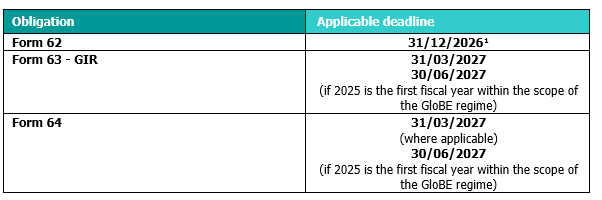
Order no. 114/2026-XXV, of 1 September, allowed entities within its scope to file Form 62 without surcharges or penalties until the last day of the 12th month following the end of the fiscal year. For entities with a fiscal year coinciding with the calendar year, this corresponds to 31 December 2026. The aforementioned Order applies exclusively to Form 62 and does not affect the deadlines applicable to Forms 63 and 64.
It should also be noted that Form 62 is not necessarily an annual filing obligation. If the group became subject to the GloBE regime for the first time in 2024 and Form 62 has already been filed, a new Form 62 for 2025 should only be filed if there are changes to the information previously reported.
- Form 63
For entities with a fiscal year coinciding with the calendar year, the deadline applicable to Form 63 for fiscal year 2025 is, as a general rule, 31 March 2027, corresponding to the 15-month period following the end of the fiscal year.
If 2025 is the first fiscal year within the scope of the GloBE regime, the 18-month deadline applies, ending on 30 June 2027.
- Form 64
For entities with a fiscal year coinciding with the calendar year, and where top-up tax is payable in Portugal, Form 64 must, as a general rule, be filed by 31 March 2027, corresponding to the 15-month period following the end of the fiscal year.
If 2025 is the first fiscal year within the scope of the GloBE regime, the 18-month deadline applies, ending on 30 June 2027.
In summary:
¹ Deadline resulting from SEAF Order no. 114/2026-XXV, for entities within its scope.
Key points to retain
In practical terms, entities within the scope of the GloBE regime should pay particular attention to the distinction between fiscal years 2024 and 2025, the nature of each filing obligation and the relevant tax period.

¹ SEAF Order no. 158/2025-XXV.
² SEAF Order no. 114/2026-XXV.
³ SEAF Order no. 76/2026-XXV.
In particular, the following should be confirmed:
- whether the entity is part of a group within the scope of the GloBE regime;
- whether a new Form 62 is required for 2025;
- whether the GIR will be filed in Portugal or centrally in another jurisdiction, as permitted under the GloBE regime;
- whether top-up tax is payable in Portugal and, consequently, whether Form 64 is required; and
- which deadlines specifically apply, taking into account the entity’s tax period.
How can we help?
Given the complexity of the GloBE regime and the fact that the applicable filing obligations and deadlines depend on the specific circumstances of each group, Nexia is available to assist entities in assessing their position and complying with the respective filing obligations.
Nexia can support groups within the scope of the GloBE regime / Pillar 2, namely:
- confirming whether Portuguese entities fall within the scope of the GloBE regime;
- reviewing Form 62 already filed, including the jurisdiction indicated for the purposes of central filing of the GIR;
- assessing whether Form 62 needs to be filed or replaced for fiscal years 2024 and 2025;
- confirming whether the local filing of the GIR in Portugal may be dispensed with where it is filed centrally in another jurisdiction and the conditions provided for under the GloBE regime are met;
- carrying out a preliminary assessment of whether top-up tax is payable in Portugal;
- assessing whether Form 64 needs to be filed;
- coordinating with the group’s central Pillar 2 team and advisers in other jurisdictions within the Nexia network; and
- preparing supporting documentation for the position adopted before the Portuguese Tax and Customs Authority.
***
As informações acima não pretendem ser uma análise exaustiva à totalidade das alterações ao regime legal vigente, mas uma seleção daquelas que entendemos serem as mais relevantes, e não dispensam a consulta da nossa Empresa e/ou diplomas às quais as mesmas se referem.
Para mais informações contacte: Catarina Breia (+351 91 7575 832 ou cbreia@pt-nexia.com) do nosso Departamento Fiscal.